
To get recommended by ChatGPT, your business needs two things. First, OpenAI's search crawler must be able to reach your site. Second, the sources ChatGPT reads for your category must describe you consistently and correctly.
You cannot buy or submit a recommendation, because OpenAI documents no owner portal and no listing form. You control three things: access, clear facts on your own site, and consistency across directories, reviews and media.
How does ChatGPT decide which businesses to recommend?
OpenAI does not publish ranking factors for business recommendations. It does document how content gets into ChatGPT search. Independent tests show what happens after that. For the wider picture, see our research on how the rules of visibility change from SEO to GEO.
Model memory vs live web search
ChatGPT can answer from memory, meaning what the model learned from its training data, which may be months old. It can also search the web in real time. ChatGPT search, the real-time feature fed by OpenAI's crawler, launched on 31 October 2024. For questions about local services, prices or "the best X", fresh facts come from search.
OpenAI's Publisher FAQ says any public website can appear in ChatGPT search. For your content to show up in summaries and snippets, your site must not block OAI-SearchBot. That is the one technical requirement OpenAI states.
ChatGPT rewrites vague questions
ChatGPT often turns a vague question into a more specific search. Vulkan Creative, describing OpenAI's help article, gives an example. If someone at a San Francisco address asks for "good restaurants near me", ChatGPT may search for "top restaurants San Francisco". The vague question becomes a service plus a place. Your pages and listings should state both plainly: what you do and where you do it.
What OpenAI does not document
- No ranking formula. Anyone who claims to know "the ChatGPT algorithm" for businesses is guessing.
- No owner portal or sign-up. OpenAI documents no way to register a business, nothing like Google Business Profile.
- No Search Console equivalent. As Gagan Ghotra notes, you cannot submit URLs or check your index status. OpenAI's docs do describe "offline web search", which uses indexed and cached web content for eligible workspaces.
- No paid placement in answers. OpenAI's publisher documentation describes no way to pay for a place in answers. If someone offers you ChatGPT advertising, read OpenAI's current announcements to see what it includes and how ads are kept apart from answers.
What independent studies actually measured
Because OpenAI documents so little, small independent tests are the best evidence available. Here are the most recent ones we found.
| Study | Date and sample | What it found |
|---|---|---|
| Ryan Doser | 7 Oct 2026; 250 picks from ChatGPT, Claude, Gemini and Perplexity for 6 home services in Omaha and Boise | 97.6% of picks were real businesses serving the area (98.3% of ChatGPT's 58 picks). 31.0% of ChatGPT's picks were in Google's local top 3, out of a possible 62.1%. When 12 answers were rerun, on average 79.1% of the businesses came back. |
| Linktech | 27 Sep 2026; 20 local-business questions in Orange County and the Inland Empire, web search on | In 19 of 20 answers, ChatGPT showed a business list with ratings and review counts. The first written pick matched the top of that list 18 of 19 times. 85% of cited sources were directories. Only 2 citations were a business's own website. |
| Pluspoint | August 2026; 210 ChatGPT answers to dining questions in 11 US cities | City and national editorial sites made up 48.9% of cited domains. Google, Bing, Apple and Yelp listing pages made up 0%. The business's own website was about 4%. |
| Muck Rack (as reported by Everything-PR) | May 2026 analysis of AI citations | Earned media, broadly defined, made up 84% of AI citations. Paid or advertorial content made up 0.3%. |
At first the results seem to conflict. Directories dominate in one study, while listing pages get 0% in another. Mostly, the question types differ. Linktech's local-business questions pulled mostly from directories. Pluspoint's dining questions pulled from local guides and food media.
The samples are also small. Doser lists his own limits: two cities, one day, one question wording. He says the test cannot show that Google ranking caused any mention. He also discloses that Claude ran the checks and that he sells a Claude-related product.
So the practical lesson is not "focus on directories" or "focus on press". Open the citations ChatGPT shows for your questions and see which sources it relies on.
How to check what ChatGPT says about your business today
Before you change anything, record a baseline: what ChatGPT says about you today. This takes an hour or two.
- Write 10–20 questions your buyers actually ask. Mix four types: service plus place ("emergency plumber in Boise"), "best X for Y" ("best accounting software for a 10-person agency"), comparisons ("[your brand] vs [competitor]") and direct questions ("What is [your brand]?", "How much does [your brand] charge?").
- Use a temporary chat. That way your past conversations and saved memory do not shape the answer.
- Run each question 2–3 times. In Doser's reruns, only 79.1% of businesses from the first run appeared again. One answer is a sample, not a verdict.
- Record four things per answer: which businesses were named, in what order, which sources were cited, and any wrong details about you (phone, address, prices, services). A spreadsheet with one row per answer is enough.
- Repeat the questions in Gemini, Claude and Perplexity. In Doser's test, the four assistants never all put the same business first: 0 of 12 questions.
- Track referral traffic. OpenAI adds
utm_source=chatgpt.comto referral links from ChatGPT. In Google Analytics 4, open Reports → Acquisition → Traffic acquisition and filter for session source "chatgpt.com".
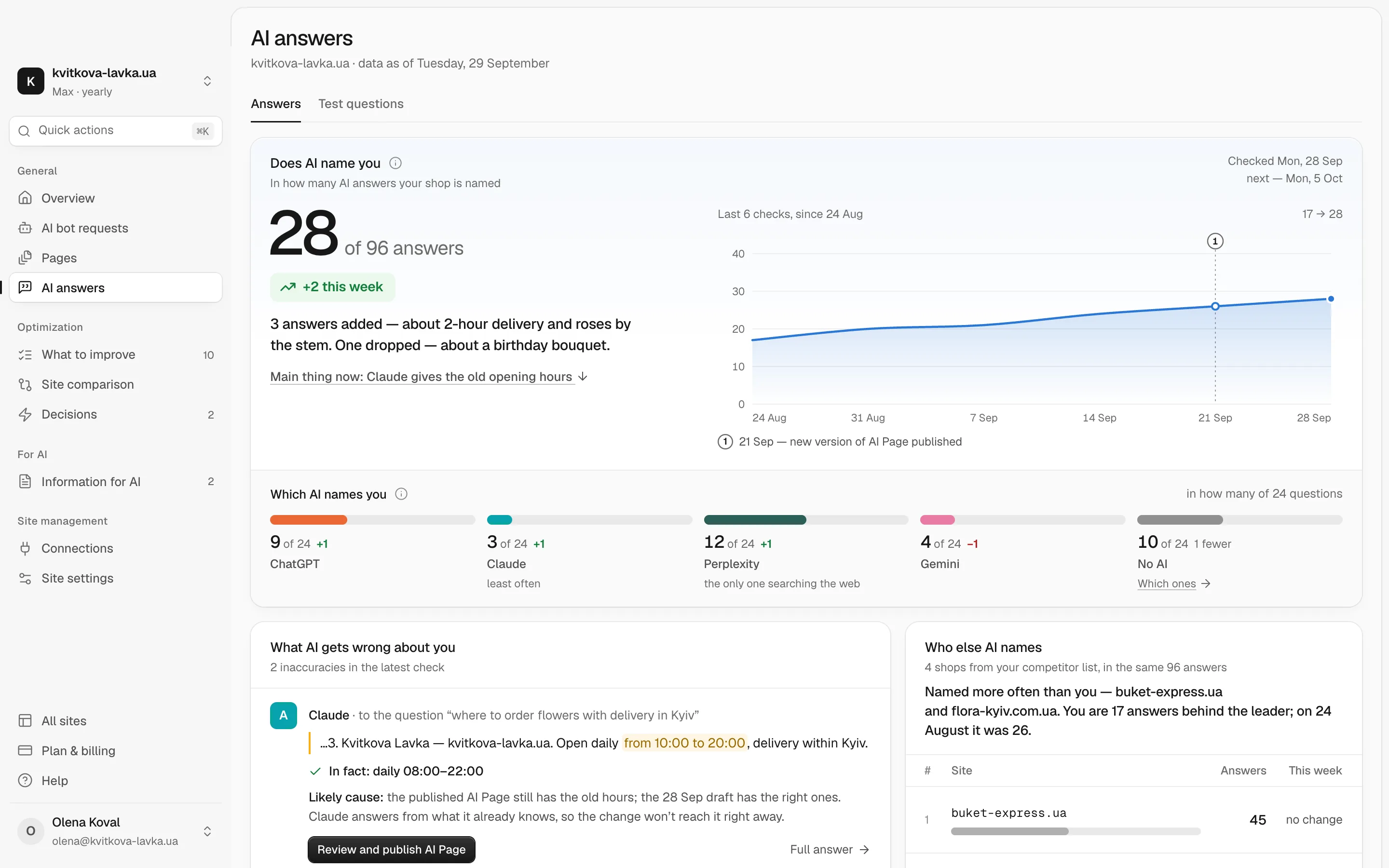
If you would rather not do this by hand, the free AI check from Chetver shows how AI assistants see your business and what to change so they name you. On the Max plan, the AI answers feature asks ChatGPT, Claude, Perplexity and Gemini your test questions every week and counts how many answers mention you.
How to get recommended by ChatGPT: what to fix first
We recommend this order. Each step builds on the one before it. If the crawler cannot reach your site, your content cannot appear in ChatGPT search, however good it is.
1. Let OAI-SearchBot in
OpenAI uses separate user agents for different jobs. A user agent is the name a bot gives when it requests a page. These three matter here:
| Bot | What it does | If you block it |
|---|---|---|
| OAI-SearchBot | Crawls pages for ChatGPT search | Your content is not shown in ChatGPT search answers. A plain link may still appear (eight25media summary). |
| GPTBot | Collects content for possible model training | You opt out of training. Search is a separate control (OpenAI). |
| ChatGPT-User | Fetches a page when a user asks ChatGPT to open it | Robots.txt rules may not apply to it. It is not used to decide search inclusion (Ansvisor summary). |
A minimal robots.txt rule that allows search looks like this:
User-agent: OAI-SearchBot
Allow: /
Then check these settings:
- Your CDN or firewall. Bot protection in your CDN or web application firewall can block OpenAI even when robots.txt allows it. Do not trust the user-agent header, because anyone can fake it. Check traffic against OpenAI's published IP list at
https://openai.com/searchbot.json, as Promptwatch explains. - Timing. According to a summary of OpenAI's crawler docs, robots.txt changes take about 24 hours to apply.
- Pages you want hidden. OpenAI says a disallowed page can still appear as a link and title if it finds the URL elsewhere. To keep a page out, use a
noindexmeta tag. Allow crawling, so the bot can read that tag.
Robots.txt only shows what you allow. Your server logs show what actually happens. Pulse shows which bots from ChatGPT, Claude, Gemini and others visit your site, what they read and where they hit errors. Each problem comes with advice on what to change.
2. Make your facts consistent and correct
In Doser's test, the phone number given did not match the live Google listing in 7 of 250 picks (2.8%). ChatGPT's misses were about details, such as a website that now redirects to a domain marketplace. Errors like these trace back to data you can fix:
- Use one business name, one phone number and one address everywhere.
- Keep your Google Business Profile, opening hours and prices current.
- Renew your domain and set redirects when you move pages.
- Close old listings for former addresses, numbers or brand names.
3. Say plainly what you do, for whom and where
Pronto Marketing tested its own company with 21 questions. This was a company self-test, not an independent study. ChatGPT got the main services right. It assumed the company did not offer services its site rarely mentions. Where the site was vague, ChatGPT invented an ideal client size. Comparison questions got the weakest answers.
For example, imagine a family dental clinic whose site says only "complete dental care". ChatGPT has no clear signal that the clinic does children's orthodontics or Saturday emergency visits. Give each service its own page that names the city and the hours. Then the search step has something concrete to match.
- Create one page per service, and name the area you serve.
- State who you work with: company size, industries, types of patients or clients.
- Publish prices or price ranges where that is normal in your market.
- Add an honest comparison page that explains how you differ from common alternatives.
4. Be present on the sources ChatGPT cites for your category
Go back to your baseline spreadsheet and list the cited domains. For local services, the Linktech study suggests you will see mostly directories and review platforms. For restaurants and other hospitality businesses, expect local guides, city media and tourism portals, as in the Pluspoint study. For B2B and SaaS, look for industry media, "best tools" roundups and forums. Check that you appear on these sources, with the same facts you use everywhere else.
5. Earn reviews and genuine mentions
In the Linktech study, ChatGPT showed ratings and review counts next to its business list. Yet the most-reviewed business was first only twice, so review volume alone did not decide the order. Ask happy customers for reviews regularly. Earn coverage through real news, expert comments and partnerships. Avoid fake reviews and planted forum posts: they break review platforms' rules and put the trust you are building at risk.
Give AI one clean source of your business facts
Your facts are often spread across a dozen pages. An AI Page brings them together in one place: prices, opening hours, contacts and services, written for ChatGPT, Claude and other AI assistants. Chetver builds it from your website, and you publish it on aipage.yoursite.com. It comes with an llms.txt file. That is a plain-text file that gives language models a short guide to your content.
Be realistic about llms.txt. OpenAI does not document it as a signal for ChatGPT search. Our research on llms.txt and the other AI-crawler signals in 2026 covers what each signal does and does not do.
One case shows what can change. Sereda.ai, a Ukrainian HR platform, published its AI Page on 22 October 2025. Before that, ChatGPT said it did not know the product, and Sereda.ai barely appeared in lists of HR tools. Two researchers scored the answers independently on 5 criteria × 10 points, scaled to 100 and averaged over 4 questions. ChatGPT's score went from 24 to 87, and Gemini's from 28 to 91. "Before" is September to early October 2025; "after" is early December 2025. Details are in the Sereda.ai case study. This is one case, not a promise for every business.
How to measure progress over time
Single answers vary too much to judge one change. Track trends instead:
- Keep your question set fixed. If you change the questions, you can no longer compare results month to month.
- Rerun the questions monthly, each 2–3 times, in the same assistants.
- Calculate your share of answers. This is the share of answers that mention you, often called share of model. See our Share of Model research for how to measure it.
- Count wrong details about your business. This number should go down as you fix your listings.
- Watch referral sessions from
utm_source=chatgpt.comin Google Analytics.
Expect different speeds. Crawler access can change within about a day of a robots.txt fix. OpenAI documents no timeline for changes in answers, so judge progress over months, not days.
Your next step
This week, do two things. First, open your robots.txt and firewall settings and confirm that OAI-SearchBot is allowed. Then ask ChatGPT ten buyer questions in a temporary chat and write down what it says about you. Those two checks will show which of the fixes above to start with.
Frequently asked questions
Can I submit or pay to list my business in ChatGPT?
No submission route is documented. OpenAI documents no submission form, owner portal or Search Console equivalent for businesses, and its publisher documentation describes no paid placement in answers. ChatGPT finds you through web search. Allow OAI-SearchBot and make sure the sources it cites describe you correctly.
Does blocking GPTBot remove my site from ChatGPT?
No. According to OpenAI, GPTBot controls whether your content may be used for model training. Search is controlled separately by OAI-SearchBot. You can block GPTBot and still appear in ChatGPT search, as long as OAI-SearchBot is allowed.
Why does ChatGPT recommend my competitor and not me?
Usually the competitor is easier to find and to describe. It may be listed on the directories, guides or media that ChatGPT cites for your category, with clear and consistent facts. Open the citations in the answer and check whether you appear on those sources. Then look for wrong or missing details about your business.
Does ChatGPT use Google Business Profile?
OpenAI does not document that it does. In Ryan Doser's October 2026 test, 31.0% of ChatGPT's local picks were in Google's local top 3, out of a possible 62.1%. The author says this does not prove cause. Keep your profile current anyway: Doser checked phone numbers in AI answers against the live Google listing, and his advice for fixing wrong details starts there.
How long does it take to show up in ChatGPT?
Robots.txt changes for OpenAI's crawler take about 24 hours to apply, according to a summary of OpenAI's docs. OpenAI documents no timeline for changes in answers. Rerun the same questions monthly and judge the trend over several months.
Do ChatGPT and Gemini recommend the same businesses?
Often not. Doser cites the Steady Demand AI Citation Ledger, which found that ChatGPT and Gemini named the same top business only 4.9% of the time. In Doser's own test, only 6 of 72 head-to-head comparisons of first picks matched. Check each assistant separately.