
Does schema markup help AI search? It helps, but less than most advice claims. Schema.org markup helps search engines read your business facts and earns Google rich results. But there is no evidence that it gets a page cited by ChatGPT on its own. A new University of Toronto study compared pages within the same website and found no significant effect from schema, FAQ blocks or summary boxes. Retrieval mattered far more. Retrieval means which pages the AI's own search finds in the first place.
So the order of work is simple. First make sure AI search can find and read your pages. Then keep your schema accurate. This guide covers the data behind that advice and a fix-first checklist.
Does schema markup help AI search? What the citation data says
Schema markup is code in your page's HTML that describes facts such as your name, address or prices in the shared schema.org vocabulary. It is usually written as JSON-LD, a small block of structured text that visitors don't see. Plenty of guides say this markup helps AI "understand" your site. Few of them cite data that can test the claim properly.
The study: 158,099 AI answers from two markets
On 10 October 2026, Mahe Chen and Nick Koudas of the University of Toronto published "What Drives AI Citations? Content, Retrieval and Model Knowledge in Generative Engine Optimization (GEO)" (arXiv 2610.15033). They looked at two 90-day collections of answers to commercial questions: 158,099 answers with 468,037 citations in total.
- Main dataset: US home internet. 651 questions written for a US fiber provider, 143,249 answers, 396,188 citations. Collected daily from 24 June to 21 September 2026.
- Second dataset: small business-software vendors. 55 questions, 14,850 answers, 71,849 citations.
The answers came from public APIs with web search turned on: ChatGPT (GPT-5.4 nano with web search), Gemini (Gemini 3.1 Flash Lite with Google Search grounding) and Perplexity (Sonar). In this study, "schema.org markup" means any JSON-LD or microdata type. "Summary box" means an opening TL;DR, key takeaways or quick-answer passage.
Across websites, every popular practice seems to work
When the authors compared different websites with each other, every commonly recommended practice looked helpful, and every result was statistically significant. Pages with an FAQ block got 18.1% more citations. Summary boxes went with 20.9% more, author boxes with 14.9% and schema markup with 7.5%. A page that loaded one standard deviation faster got 11.7% more.
Many "schema boosts AI visibility" claims rest on cross-site comparisons like these. The next comparison shows why they can mislead.
Within one website, none of them is significant
The authors then compared pages within the same website. This removes everything that differs between sites, such as brand strength, domain age and how well known the company is. Once they did that, none of the practices had a significant effect.
| Page feature | Between websites | Within one website |
|---|---|---|
| FAQ block | +18.1% (significant) | −3.4% (not significant) |
| Summary box | +20.9% (significant) | +6.9% (not significant) |
| Author box | +14.9% (significant) | −4.6% (not significant) |
| Schema.org markup | +7.5% (significant) | −5.3% (not significant) |
| Page speed (+1 SD) | +11.7% (significant) | −1.1% (not significant) |
The authors explain this as Simpson's paradox: a trend that shows up across groups disappears or reverses inside each group. Websites that get cited a lot for other reasons also tend to use these practices. FAQ blocks appear on 43% of pages on the most-cited quarter of websites, compared with 23% on the least-cited quarter. So the data suggest the FAQ block is not what earns the citations. It is simply more common on sites that get cited anyway.
"Not significant" does not mean zero. It means the data can't tell the effect apart from noise. That is still a long way from "add schema to get cited".
What this study can and can't tell you
The authors list the limits themselves. Keep them in mind:
- Associations, not causes. The study observes patterns. It did not add or remove schema and then measure what changed.
- APIs and small models, not consumer apps. The ChatGPT app you use may not behave like GPT-5.4 nano through the API. Perplexity's answers could not be replayed at all.
- English questions about the US market. The questions were written for organizations that use the authors' monitoring platform, not taken from real user logs.
- About a third of cited URLs could not be analyzed. Only 63.2% of the 39,059 cited URLs in the main dataset returned usable HTML.
- Data support. The answers were collected by a monitoring platform the authors run, and the acknowledgments thank the team at ktau.ai for help with the data.
Why retrieval decides which pages get cited
If page features explain so little, what explains more? The study's answer is retrieval.
Every page ChatGPT cited came from its own search
For each answer, ChatGPT rewrites the question into its own sub-queries and runs them through its search. This is called query fan-out: one question becomes several searches. In the study, every page ChatGPT cited was one its own search had retrieved. Which pages that search returned explained 32% of the variation in citations between pages of the same site. All page properties together explained 2.8%. Both numbers are for ChatGPT, not for every engine.
At the same retrieval rank, schema markup (×0.92), FAQ blocks (×0.93) and author boxes (×0.77) went with slightly lower odds of being cited. Brand pages went with higher odds (×1.71). Rank alone explained 26.8% of which result got chosen. Adding every match and page feature raised that only to 32.5%.
The engines also have their own rankings. Their sub-queries rarely match Google's or Bing's results, and they cite mostly from the top of their own list. Ranking well on Google doesn't automatically put you there.
What did matter: pages that match the question
The content effect that held up within websites was relevance. When the best paragraph on a page matched the question one standard deviation better, the page got 15.5% more citations (95% CI 11.1–20.1%). Title match added 14.1% and word overlap 9.1%. For ChatGPT alone, title match had no effect (−0.2%), because ChatGPT searches with its own rewritten queries rather than the user's wording.
The number of prices or places mentioned on a page had no effect. Pages that named more of the tracked brands got 11.8% more citations per standard deviation. That pattern would favor comparison and list pages.
Brands the model already knows get searched more
What the model already knows matters too. ChatGPT wrote a brand into its search queries 67% of the time when the brand was in its prior knowledge, and 11% of the time when it wasn't. In 46% of cases where ChatGPT mentioned a brand the user hadn't named, no cited page backed up the mention. Schema markup on your own pages doesn't address this. The model's prior knowledge comes from what it learned about your brand before the search.
ChatGPT searches your own site for "official" facts and prices
A second study shows where those sub-queries go. Ahrefs analyzed 66.6 million free, logged-out ChatGPT responses (model GPT-5.6 Luna) from August and September 2026, in all countries, and the 15 million fan-out queries behind them. 14.4% of responses contained fan-out queries, about 1.6 per response that had them.
- 6.8% of fan-out queries used the
site:operator, which limits a search to one domain. They covered about 116,000 domains. - Among the roughly 160 domains that got the most
site:searches, 75.9% of those searches went to brand sites, 11.9% to retailers, and 1.9% to Reddit and Facebook combined. - In English fan-out queries, "official" grew from 10.1% in August to 13.1% in September. "Price" grew from 6.0% to 8.9%. After "2026", these were the most common words.
Ahrefs concludes that ChatGPT increasingly goes to whoever owns the information, such as the brand that sets the price. They also caution that this could change with the next model update. The practical point: ChatGPT may search your own website for your prices and official details. If no crawlable page holds those facts, it won't find them there.
Which schema types are still worth adding
None of this makes schema useless. It means schema is the wrong tool for getting cited. It still does two useful jobs.
Google rich results and merchant listings. Product and Offer markup feeds price and availability into Google's shopping features. For AI features specifically, Google's documentation on AI features says that appearing in AI Overviews or AI Mode needs no additional requirements or special optimization beyond normal Search eligibility.
Clear entity facts. Google documents Organization markup as a way to help it understand your name, logo, address, contacts and official profiles. Google's structured data guidelines require the markup to describe the visible main content. Marking up hidden content can make a page ineligible for rich results.
| Schema type | What it does | What it doesn't do for AI | Verdict |
|---|---|---|---|
| Organization | States name, logo, address, contacts and sameAs profiles in one consistent place | Doesn't get your pages retrieved or cited | Add on the home or about page |
| LocalBusiness | Opening hours, address and phone for local search | Doesn't replace a visible contacts page that AI search can retrieve | Add if you serve customers at a location |
| Product / Offer | Price, availability and merchant listings in Google | No proven effect on ChatGPT citations; in the Toronto study, the number of prices on a page had no effect | Add for online stores; keep prices in sync |
| FAQPage | Labels question-and-answer content | Not significant within websites (−3.4%); Google limited FAQ rich results in 2023 to well-known government and health sites | Optional; write good answers first |
| HowTo | Labels step-by-step instructions | Google deprecated HowTo rich results in 2023 | Low priority |
What to fix first, before you add more schema
Do these four steps in order. Each one comes before schema, because it decides whether AI search can reach your facts at all.
- Check which AI bots your robots.txt lets in.
- Serve your key text in server-rendered HTML.
- Stop serving errors and blocks to AI crawlers.
- Publish crawlable pages that answer "official" and "price" queries.
1. Check which AI bots robots.txt lets in
Each AI company runs separate bots for search, for user requests and for training, and you control them separately.
| Bot | Company | What it does | Recommendation |
|---|---|---|---|
| OAI-SearchBot | OpenAI | Shows sites in ChatGPT search; disallowed sites aren't shown in search answers, though they can still appear as navigational links | Allow |
| ChatGPT-User | OpenAI | Fetches pages when a user asks in ChatGPT; robots.txt may not apply to these user-initiated requests | Allow, and don't block it in your firewall |
| GPTBot | OpenAI | Training | Your choice |
| Claude-SearchBot | Anthropic | Improves Claude's search results | Allow |
| Claude-User | Anthropic | Fetches pages when a user asks Claude | Allow |
| ClaudeBot | Anthropic | Training | Your choice |
| PerplexityBot | Perplexity | Surfaces and links sites in Perplexity; not used for training foundation models | Allow |
| Perplexity-User | Perplexity | User-initiated fetches; generally ignores robots.txt | Make sure your firewall or bot protection doesn't block it |
| Googlebot | Search, including AI Overviews and AI Mode | Allow |
Sources: OpenAI, Anthropic, Perplexity. A minimal robots.txt section that keeps the search and user bots open looks like this:
User-agent: OAI-SearchBotAllow: /User-agent: ChatGPT-UserAllow: /User-agent: Claude-SearchBotAllow: /User-agent: Claude-UserAllow: /User-agent: PerplexityBotAllow: /
One caveat from the Toronto study: robots.txt isn't a perfect switch. 7.1% of the pages ChatGPT cited disallowed OAI-SearchBot, and 19.9% of the pages Gemini cited disallowed Googlebot. Allowing bots lets them read your current content. It doesn't force a citation. For llms.txt and the other signals you can send to AI crawlers, see our research llms.txt and the other AI-crawler signals in 2026.
2. Serve the key text in server-rendered HTML
Server-rendered means the text is already in the HTML your server sends, not added later by JavaScript in the browser. Vercel and MERJ found that major AI crawlers, including GPTBot and ClaudeBot, downloaded JavaScript files but didn't run them. In the Toronto study, 11.5% of downloaded pages needed JavaScript for their main text. Within websites, Gemini cited these pages significantly less (−10.6%). The drops for ChatGPT (−6.8%) and Perplexity (−2.1%) were not significant.
To test a page, open "View source" in your browser, or fetch it with curl, and search for your prices and phone number. If they aren't in the raw HTML, a bot that doesn't run JavaScript won't see them.
3. Stop serving errors and blocks to AI crawlers
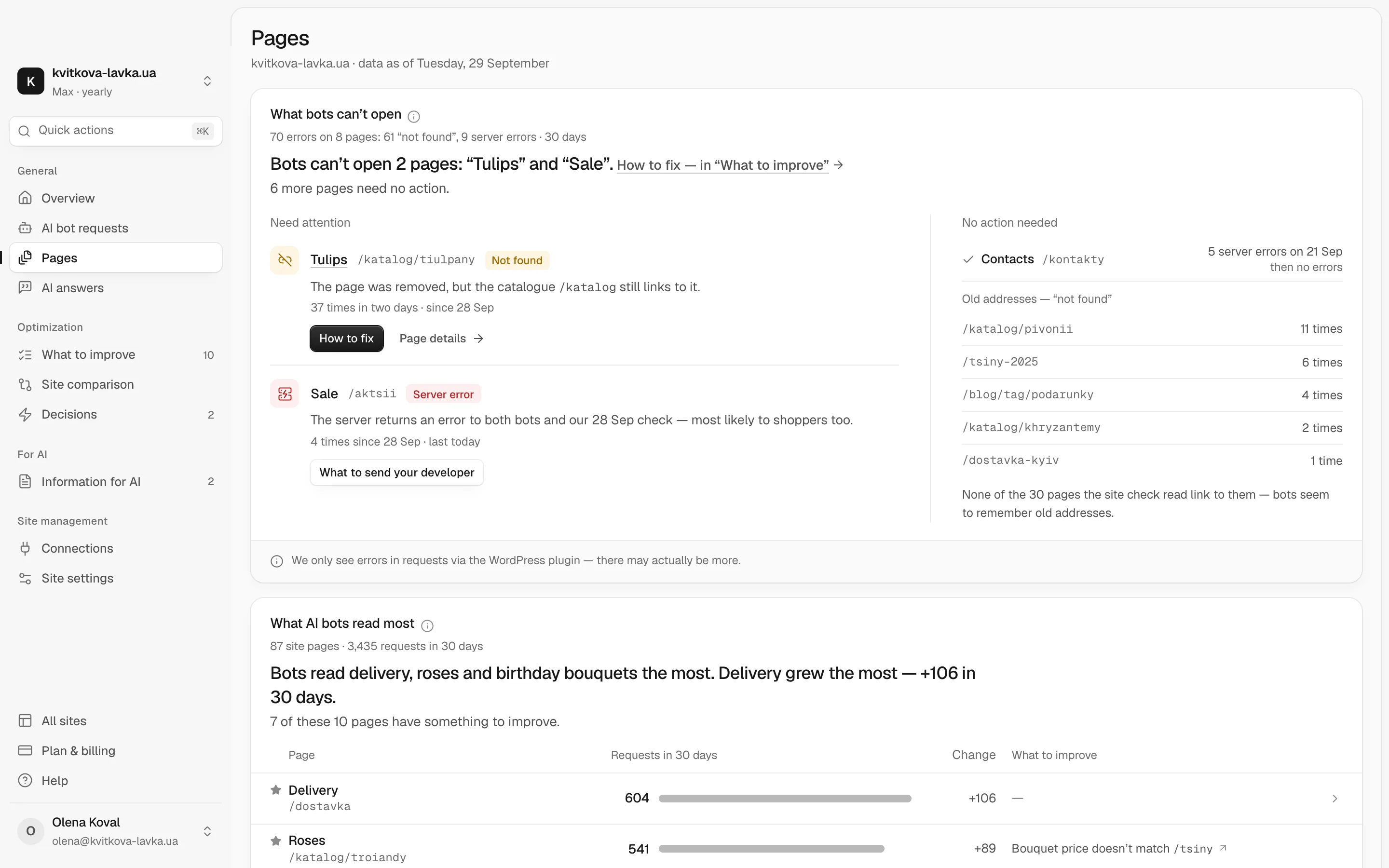
Firewalls, bot protection and rate limits can answer AI bots with 403 Forbidden or 5xx server errors, and nobody may notice. Blocking is common: among the pages the engines did cite, 18.9% disallowed the researchers' crawler in robots.txt and 7.3% refused it with HTTP 403. Check your server logs for the bot names in the table above and look at the status codes they receive. Pulse shows which bots from ChatGPT, Claude, Gemini and others visit your site, what they read and where they run into errors, with advice on what to change.
4. Publish crawlable pages that answer "official" and "price" queries
ChatGPT runs site: searches for official facts and prices. So make sure your site has plain, crawlable pages for prices, contacts, opening hours and services. The Toronto data suggests that adding more price mentions doesn't help. What helps is a page whose title and paragraphs clearly answer the question someone would search.
For example, imagine a dental clinic whose prices exist only in a PDF and whose opening hours appear only in an image. A search for "[clinic name] official price list" finds nothing on the site to retrieve. One HTML page with the price list, hours and address as text fixes that. Chetver's AI Page puts these facts on one page: Chetver builds it from your website with your prices, hours, contacts and services, you publish it on aipage.yoursite.com, and it comes with an llms.txt file.
How to check whether AI search can reach your facts
You can't watch a citation happen, but you can check each link in the chain:
- Access: read your robots.txt and compare it with the bot table.
- Visits: look in your server logs for OAI-SearchBot, ChatGPT-User, Claude-User and PerplexityBot, and note the status codes they get.
- Readability: confirm that your key facts appear in the raw HTML.
- Schema: run your markup through a validator and confirm that every value matches what visitors see on the page.
- Answers: ask ChatGPT, Claude, Perplexity and Gemini the same few questions about your business every week. Note whether you're mentioned and whether the facts are right.
Chetver covers several of these checks: Pulse for bot visits and errors, and, on the Max plan, a weekly count of how many ChatGPT, Claude, Perplexity and Gemini answers to your test questions mention you. Plans and what each includes are on the pricing page. No tool or action can guarantee that an AI assistant will cite you. These checks show whether anything on your side is in the way.
The bottom line: retrieval first, schema second
Schema markup is worth keeping for Google rich results and for clear, consistent business facts. The best data available today doesn't support it as a way to get cited by ChatGPT. Retrieval and relevance matter more: can AI search reach your pages, read them without JavaScript, and find a page that answers the question it actually searched? For more on how the rules of visibility are changing, read our research from SEO to GEO.
One next step: run the free AI check to see how AI assistants see your business today and what to fix first.
Frequently asked questions
Can ChatGPT read JSON-LD schema on my page?
JSON-LD is text inside your HTML, so any bot that downloads the page receives it. We have not found OpenAI documentation that explains whether or how ChatGPT search uses it. In the University of Toronto study, schema markup had no significant effect on citations when pages of the same website were compared. Put your key facts in visible text too.
Is FAQ schema still worth adding in 2026?
Only as a low priority. In 2023 Google limited FAQ rich results to well-known government and health websites. In the Toronto study, FAQ blocks went with 18.1% more citations across websites but −3.4% (not significant) within the same website. Clear answers on the page matter more than the markup around them.
Does schema markup help with Google AI Overviews and AI Mode?
Google's documentation says there are no extra requirements or special optimizations for AI Overviews or AI Mode beyond normal Search eligibility. Schema still helps with regular rich results and merchant listings, as long as it matches the visible content of the page.
Does llms.txt replace schema markup?
No. They do different jobs. Schema describes facts on a specific page for search engines. llms.txt is a file that points AI tools to your key content. Neither one replaces crawlable HTML pages that AI search can retrieve.
Should I block GPTBot but allow OAI-SearchBot?
You can. OpenAI lets you control them separately in robots.txt. GPTBot is used for training. OAI-SearchBot controls whether your site can appear in ChatGPT search answers. If you want to be found in ChatGPT, keep OAI-SearchBot and ChatGPT-User allowed, whatever you decide about training. Also make sure your firewall doesn't block them.