
ChatGPT shows source links only when it runs a live web search for an answer. Since 31 October 2026, it appears to skip that search more often. In Goodie's tracking, the share of answers with no sources jumped from 1.5% to 12.2% in a single day.
When ChatGPT is not citing sources, the answer most likely comes from what the model already learned. So getting cited is only half the job. The facts about your business across the web also have to be right.
Why is ChatGPT not citing sources? What changed in late October 2026
Two separate changes landed within the same two weeks. Keep them apart, because each one calls for a different response.
Fewer answers with links
Goodie's study collected 94,851 answers from the ChatGPT web interface between 9 October and 9 November 2026, about 3,000 a day. Goodie sells AI search analytics, and it says so in the study.
From 9 to 30 October, the daily share of answers with zero sources never went above 2.1%. On 31 October it jumped to 12.2%. It stayed at or above 10% every day through 9 November, the end of the sample. Citations per answer dropped from 5.44 to 4.53.
About 63% of the lost citations came from answers that cited nothing at all. The other 37% came from answers that still searched but cited slightly fewer sources: 5.16 on average instead of 5.52.
Goodie thinks the most likely cause is that ChatGPT now searches the web less and answers from training data more often. Training data is the text a model learned from before release, and it stops at a cutoff date.
A different mix of cited sites
Searchable analyzed 12.8 million pages that ChatGPT listed as sources between 17 October and 9 November 2026. Sites outside ChatGPT's 10,000 most-cited domains went from 43.9% to 48.4% of cited pages. The shift happened in one step: the share was already 47.5% on 25 October.
| Site group (Searchable) | Relative change in share of cited pages |
|---|---|
| −66% (0.42% → 0.14%) | |
| High-authority news sites | −59% (1.14% → 0.47%) |
| Wikipedia | −71% |
| YouTube | −74% |
| Brand and company sites, high authority | −6% |
| Brand and company sites, lower authority | +8% |
| Review and comparison sites, high / lower authority | +9% / +11% |
"High authority" here means more than 1 million monthly organic visits, by Ahrefs' estimate. The +8% applies only to smaller brand sites, not to company websites in general.
Goodie, meanwhile, says the source mix barely moved on 31 October: Reddit appeared in about 2% of answers both before and after. So late October brought two changes. One changed which sites get cited. The other changed how often ChatGPT cites anything at all.
What OpenAI shipped around the drop
OpenAI's release note from 29 October 2026 says GPT-6 was updated to give more concise responses for Free and Go users and for people who are not signed in. On Plus and Pro, the change applies only to the fallback model used after GPT-6 message limits run out. The note does not mention search or citations.
Goodie links the drop to this update by timing only, and OpenAI has not confirmed the link. Goodie also lists other possible causes: ChatGPT may still search but show fewer sources, or, less likely, Goodie's measurement may have changed.
The March drop and the May rebound
This has happened before. seoClarity reported that the US zero-citation rate doubled in March 2026, from 28% to 48%. By May, citations had rebounded toward pre-March levels, and seoClarity now describes the episode as volatility, not a collapse. Different trackers use different question sets, so compare only the direction of these numbers, not the levels.
How to tell whether an answer came from live search or from model memory
Before you fix anything, find out which kind of answer you are looking at. Search answers depend on the pages ChatGPT finds today. Memory answers depend on what it learned earlier.
Check the answer itself
A search answer usually has inline citations and a Sources control below it. A normal answer that did not search may show no globe icon, no citations and no Sources panel, as this walkthrough of ChatGPT search describes.
One caution: in August 2026, Search Engine Roundtable reported that OpenAI was testing a version that puts the full source list inside the three-dot menu, according to Zenergyworks. Check that menu before you record "no sources".
OpenAI's documentation, as quoted by Trackerly, also treats sources (every URL consulted) and citations (the most relevant references) as different things. So an answer can rest on more pages than it shows.
Ask the same question twice
- Open a temporary chat so past chats and memory do not shape the answer. Make the same choice every time: always signed in on one plan, or always logged out.
- Write down your plan tier. The 29 October change applied to Free, Go and logged-out users, so their answers can differ from Plus or Pro answers.
- Ask your question as a customer would, with no extra instructions. Note whether citations appear.
- Ask the same question again with "search the web" added, or with web search turned on if your version offers it.
- Compare the two answers. If the plain answer has no links and gets your facts wrong, while the search answer gets them right, your website is probably not the problem. The gap is in what the model learned.
Check your server logs
Logs show whether ChatGPT fetched your pages while it was answering. Goodie suggests this check as a way to tell "searching less" from "showing less". OpenAI uses separate user agents for live fetches made on a user's behalf (ChatGPT-User), for its search index (OAI-SearchBot) and for training (GPTBot). Confirm the current names in OpenAI's crawler documentation before you filter your logs.
Pulse shows which AI bots visit your site, what they read and where they hit errors. You can follow bot activity over time without digging through raw logs.
A 10-question test: what ChatGPT says about you without links
Use the same questions each time, with your real brand, city and service names in place of the brackets. Run each one with and without search, as described above. Record three things: whether you are named, whether the facts are correct, and whether sources are shown.
| Question | What it reveals | A wrong or empty answer points to |
|---|---|---|
| What is [Brand]? | Whether the model knows you at all | Little about you on the open web |
| What services does [Brand] offer? | Your service list as the model sees it | An outdated site or directory listings |
| How much does [service] cost at [Brand]? | Prices | Old price pages, old marketplace or directory entries |
| Where is [Brand] and when is it open? | Address and opening hours | Inconsistent map and directory listings |
| How do I contact [Brand]? | Phone, email, booking channel | Old contacts on third-party profiles |
| Who founded [Brand] and when? | Basic company facts | A thin About page, missing Wikidata entry or press coverage |
| What are the best [category] in [city or market]? | Whether you are named without your brand in the question | Weak presence on review and comparison sites |
| Who are [Brand]'s main competitors? | Which category the model puts you in | A vague description of what you do |
| What do customers say about [Brand]? | Your reputation in the model's memory | Few or old reviews, or unanswered complaints |
| Is [Brand] a good choice for [use case]? | Whether the model links you to your target customer | Use cases that are missing or unclear in your own copy |
For example, imagine a dental clinic that moved to a new address two years ago. The search answer may show the new address from the clinic's website. The answer without links may still give the old one, because older directory pages and reviews repeated it for years. Fixing the website alone will not fix that second answer.
If you want a quick first look before you build your own sheet, the free AI check shows how AI sees your business and what to change.
Where ChatGPT's memory of your business comes from
A model learns from text that many sites repeat. Goodie describes AI visibility as three jobs: be retrieved by search, be remembered from training, and be registered in ChatGPT's own business profiles. Retrieval still decides close to nine in ten of the answers Goodie tracks. The answers that never search depend on the second job, which means consistent, widely repeated facts.
- Your own website: the About page, service and price pages, contact page.
- Directories and maps: Google Business Profile, local and industry directories, marketplaces.
- Review platforms: what customers say, and how you reply.
- Wikipedia and Wikidata: only if your business is notable enough for an entry. Wikidata is the structured database linked to Wikipedia.
- Press and trade sites: interviews, rankings, industry roundups, partner pages.
- Social profiles: LinkedIn, Facebook, Instagram, and the company description on each.
When these sources disagree, the model has no single fact to learn. We think consistency matters even more for small businesses and for local markets with little English-language coverage. This is our reasoning, not a measured result: when only a few pages describe you, each outdated page carries more weight.
Fix list: make your facts right everywhere
Publish one clear facts page
Put your core facts in one plain, dated place: what you do, services, prices, hours, locations and contacts. An AI Page with your business facts does this. Chetver builds it from your website, you publish it on aipage.yoursite.com, and it comes with an llms.txt file.
llms.txt is a plain-text file that points AI tools to your key content. Our research on llms.txt and other AI-crawler signals explains what it can and cannot do.
Neither the page nor the file guarantees a mention or a citation. They give crawlers, search answers and anyone who copies your facts one consistent source.
One example is the Sereda.ai case study. Before its AI Page, ChatGPT said it did not know the product. Two researchers independently scored answers to four questions on five criteria, scaled to 100. Scores went from 24 to 87 in ChatGPT and from 28 to 91 in Gemini. The comparison is between September–early October 2025 and early December 2025, after the AI Page went live on 22 October 2025. That is one case, not a promise of the same result.
Make name, address, phone, prices and services identical
NAP means name, address and phone number. Write one master version of each, plus your current price ranges and service names. Then copy it exactly onto your site, Google Business Profile, LinkedIn, directories and review platforms. Vested Marketing's November roundup gives the same advice in response to the drop in links: make your basic facts match everywhere.
Rewrite the About page with plain, dated facts
Replace slogans with facts a model can repeat: founding year, location, team size if you publish it, main services, customer types, markets served. Add a "last updated" date. Short, factual sentences are easier to quote correctly than marketing copy.
Correct outdated third-party profiles
- Search for your brand name together with your old address, old phone number, old prices and any former company name.
- Fix every profile you control. For the others, send a correction request to the site owner.
- Update your Wikidata entry if one exists, with a source for each fact.
- Ask publishers of older press pieces to add a correction or update note when a fact has changed.
Claim your ChatGPT Business Hub profile, and know its limits
OpenAI opened Businesses in ChatGPT in beta on 10 November 2026. Verified businesses can update key details, add product feeds with prices and availability, and see aggregated mentions, clicks and discovery topics, but not prompts or conversations. OpenAI's announcement says eligible businesses wherever ChatGPT is available can claim a profile, but physical businesses can only claim an existing listing.
Vested adds some limits. For now, local stores and restaurants can only claim existing US listings. The Hub shows the last 28 days. It does not show which questions you appear for, your competitors or other AI tools.
Most important, claiming a profile controls what the profile says, not whether ChatGPT recommends you. Claim it if you are eligible, and keep the open-web facts above as your main job.
How to measure AI answers that have no links
Why referral traffic can't see zero-link answers
No link means no click, and no click means no session in your analytics. If ChatGPT names you from memory and the customer later types your URL or searches your brand on Google, the visit shows up as direct or organic traffic.
Data from ChatGPT links is also fragile. Goodie, citing Search Engine Journal, reports that from 8 to 15 October 2026 ChatGPT links lost their tracking tags and referrer, so the visits showed up as Direct until OpenAI fixed the bug.
A monthly routine
- Keep the same 10 questions and the same conditions every month: temporary chat, the same plan tier, the same wording.
- Run each question with and without search, and record the results in a sheet.
- Track four numbers: the share of answers that show sources, the share that name you (your mention rate), the share with correct facts, and the domains cited when sources appear.
- Mark platform dates on your chart: 22–25 October (cited-site mix shift), 29 October (OpenAI's concise-answers update), 31 October (zero-source jump), 10 November (Business Hub).
- Compare month to month, not day to day. A single check tells you little.
Measure the same product your customers use. When Goodie switched from API collection to the web interface in late August 2026, its citations per answer dropped from 8.0 to 5.5. Our research on Share of Model explains how to turn mention rate into a visibility metric.
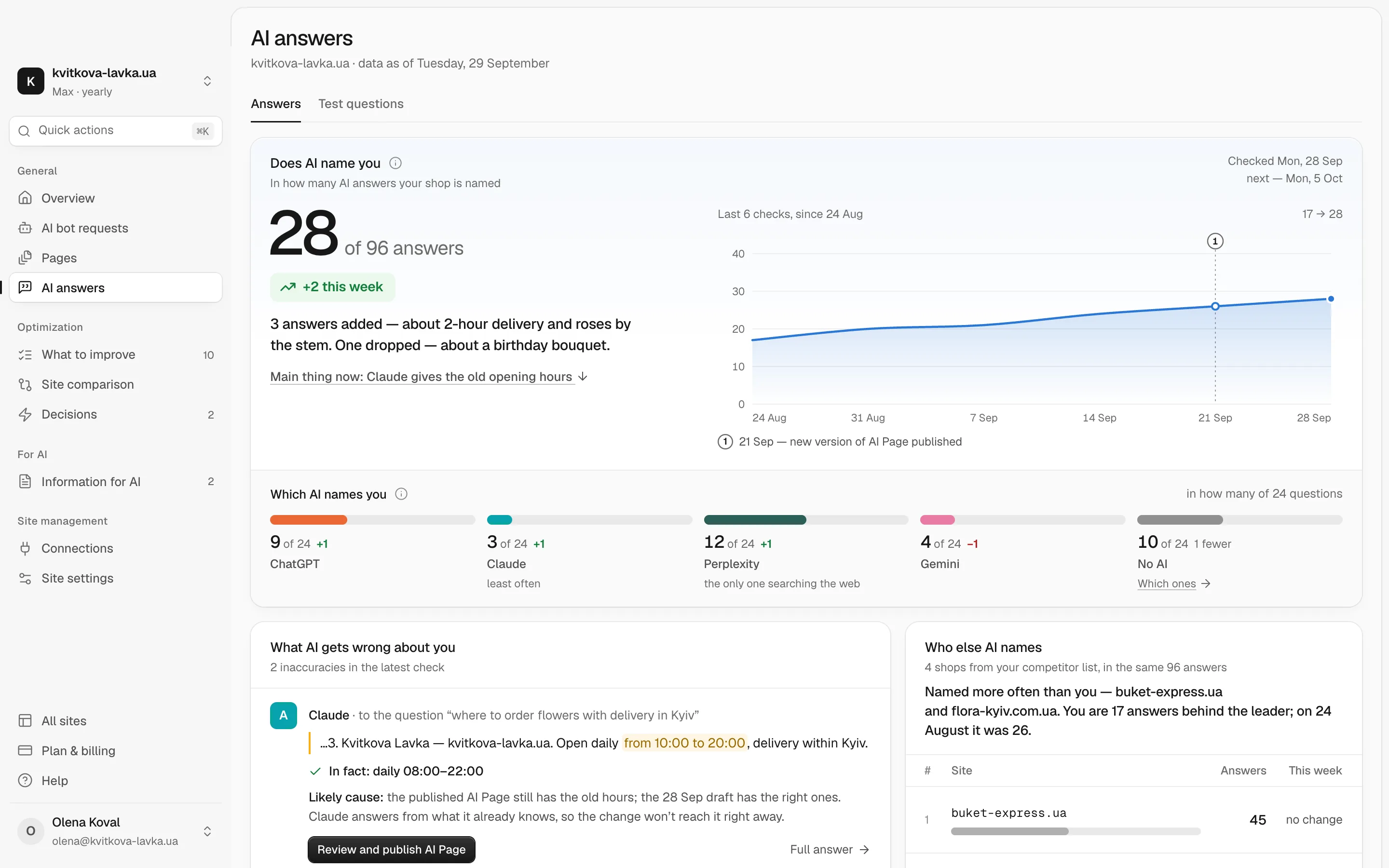
On the Max plan, Chetver's AI answers report asks ChatGPT, Claude, Perplexity and Gemini your test questions every week and counts how many answers mention you.
Will ChatGPT start citing sources again?
Nobody knows yet. Goodie expects early January to show whether the 31 October change reverses the way March did, after about two months. Either way, the same work helps. If ChatGPT searches more again, clear and consistent facts help the pages it retrieves. If it keeps answering from memory, those facts are what it remembers.
Your next step: run the 10-question test this week, with and without search. Write down every wrong fact and the source it most likely came from. That list is your fix plan for the month.
Frequently asked questions
Can ChatGPT cite sources?
Yes, when it runs a web search. The answer then shows inline citations and a list of sources. Without search, ChatGPT answers from training data and can produce references that look real but do not exist, so open every link before you rely on it.
Why doesn't ChatGPT show sources?
Sources appear only when ChatGPT searches the web for an answer. Since 31 October 2026, more answers come without sources: Goodie measured zero-source answers rising from 1.5% to 12.2%. Its most likely explanation is that ChatGPT searches less often, though OpenAI has not confirmed this. In a version OpenAI tested in August 2026, the full source list also sits in the three-dot menu, not under the answer.
How do I make ChatGPT search the web and show its sources?
Add "search the web" to your question, or turn on web search if your version offers it. Check for inline citations and a Sources control, and look in the three-dot menu too. Answers can differ between Free, Go, Plus and Pro.
Does claiming a ChatGPT Business Hub profile make ChatGPT recommend me?
There is no evidence that it does. Vested Marketing notes that claiming a profile controls what your profile says, not whether ChatGPT names you as the answer. It is still worth claiming if you are eligible, so your details are correct.
Does llms.txt make ChatGPT cite my site?
We have seen no published evidence that llms.txt alone gets a site cited. It is a plain-text file that points AI tools to your key content. Treat it as one part of keeping your facts clear and consistent, not as a ranking switch.
Is the drop in ChatGPT citations permanent?
It is too early to say. A similar drop in March 2026 reversed by May, according to seoClarity, and Goodie expects early January to show whether this one follows the same path.