
On GEO vs SEO, my view is simple: GEO does not replace SEO, and it is not just a new name for it. GEO (generative engine optimization) means working to get your business named, and described correctly, in answers from ChatGPT, Gemini, Claude and Perplexity. Most of that work is the same as good SEO. Only three things really change: how you measure success, who gets cited, and which bots read your site.
That is why I don't accept either of the pitches on the market right now. "SEO is dead" is wrong. "GEO is just SEO" is also wrong. Below I explain why, and I give you a short checklist for splitting the work.
Why everyone is asking "GEO or SEO?" this month
On 2 November, Adam Fry, who leads ChatGPT's consumer product, said that ChatGPT search volume is "roughly one-fifth (20%)" of Google's. Two caveats apply. OpenAI counts a search only when a prompt triggers a web search, and it did not say where its Google figure came from. Even so, a channel that size deserves its own measurement.
In the same week, MarketingProfs reported on interviews with 18 media buyers. They are questioning the extra value of part of their Google search budgets, commonly 10–20% and sometimes more. Look closely at the detail: this is about paid search ads, not SEO. Many of those advertisers still spend heavily on Google, and some are moving money into Google's own AI-powered campaigns.
The same report says Reddit plans to move to a mainly logged-in experience, as its search referrals fell by more than one million a week on average in October. That matters for GEO, because Reddit is a common place where businesses get mentioned by other people.
So the question is fair. The problem is that most top results for "geo vs seo" come from GEO tool vendors and agencies. They answer it with a sales pitch.
What GEO and SEO share: most of the work
Crawlable, fast, indexable pages
Google is direct about this. Its guidance on AI features says SEO best practices also apply to AI Overviews and AI Mode. A page must be indexed and eligible to show a snippet, and there are no extra technical requirements. If bots can't reach a page, it can't help you in either kind of search.
Clear facts on the page
Prices, opening hours, service areas, who you serve and what makes you different. Put them in plain text, not in images or PDFs. People need these facts, and so do AI systems.
The paper that introduced the term GEO (Aggarwal et al., 2023) found that adding citations, quotations and statistics raised a source's visibility in generated answers by up to 40%. Note the limit: that result came from a test benchmark, not from live ChatGPT or Google.
Structured data
Structured data is code (usually schema.org markup) that labels facts on a page so machines can read them, for example the business name, address or a product price. It has been part of SEO for years. It also helps any system that needs to read your facts without guessing.
Earned mentions and links
Reviews, press coverage, directory listings and industry lists help SEO through links and trust. They also help AI answers, because models and AI search tools learn about you from those same sources.
If your SEO team already does these four things well, most of your GEO work is done.
GEO vs SEO: the three things that actually change
You are measured by Share of Model, not by rank
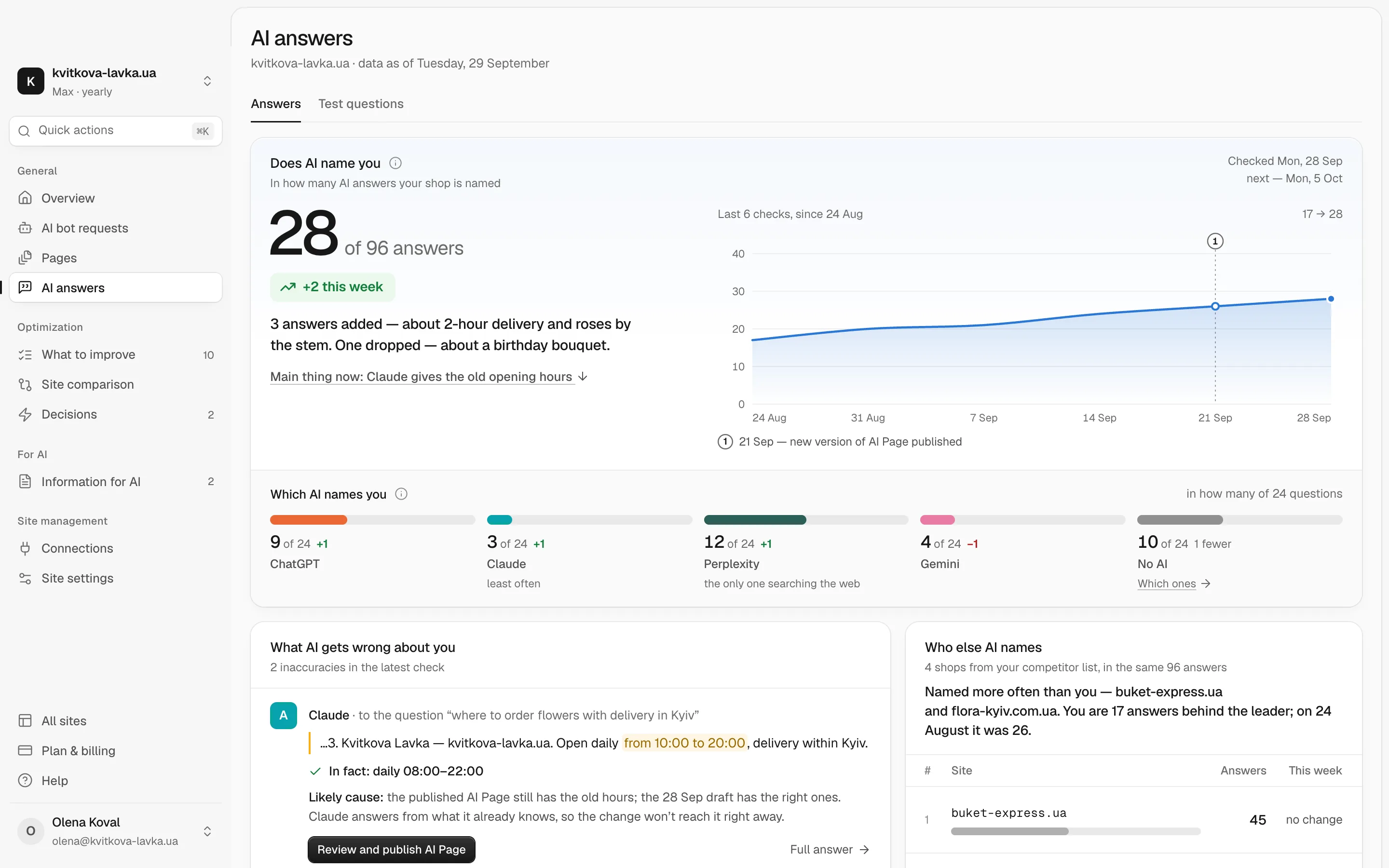
An AI answer has no "position 4". It mentions you or it doesn't. It may describe you correctly, describe you wrongly, or recommend a competitor. Share of Model is the share of AI answers to a fixed set of questions that mention your business. Answers change from one run to the next, so you need the same questions, several engines and repeated checks. A ranking report can't show any of this. Our research on measuring Share of Model explains the method in detail.
Who gets cited depends on other sites and on facts that match
In classic SEO, one strong page can win a query. An AI answer is usually built from several sources. If those sources disagree, the model may choose the wrong fact or leave you out.
For example, imagine a dental clinic whose website lists Saturday hours, while its Google Business Profile and two directories still say "closed on weekends". A person might check the website. An AI answer may repeat the version it sees most often. That is why matching facts on your website, directories, review sites and press now matter more. Our research on how visibility rules change from SEO to GEO covers this shift.
AI bots read your site differently
Google has one main crawler for Search. AI companies split their bots by job. Each bot has its own token in robots.txt, the file that tells bots which parts of your site they may crawl. The token is the name you use there to allow or block that bot. If you block the wrong one, you may disappear from answers when you only meant to opt out of training.
| Bot | Company | Job | What blocking it does |
|---|---|---|---|
GPTBot | OpenAI | Collects content that may be used for model training | Opts you out of training. It is a separate control from ChatGPT search |
OAI-SearchBot | OpenAI | Surfaces sites in ChatGPT search | OpenAI says blocked sites won't appear in ChatGPT search answers, though they can still appear as navigational links |
ChatGPT-User | OpenAI | Fetches pages for user actions in ChatGPT and Custom GPTs | Covers only visits a user starts. It is a separate control from search and training |
ClaudeBot | Anthropic | Collects training data | Opts you out of training |
Claude-SearchBot | Anthropic | Indexes pages to improve Claude's search answers | May reduce your visibility in Claude's search answers (Anthropic) |
Claude-User | Anthropic | Fetches pages when a user asks | Claude can't read your page for that user |
PerplexityBot | Perplexity | Surfaces and links sites in Perplexity results. Perplexity says it is not used to train foundation models | You may not appear in Perplexity results (Perplexity) |
Perplexity-User | Perplexity | Fetches pages for user actions | Perplexity says it generally ignores robots.txt here, because a user requested the page |
Google-Extended | Controls whether Google-crawled content may be used to train and ground Gemini models | Does not affect inclusion or ranking in Google Search (Google) |
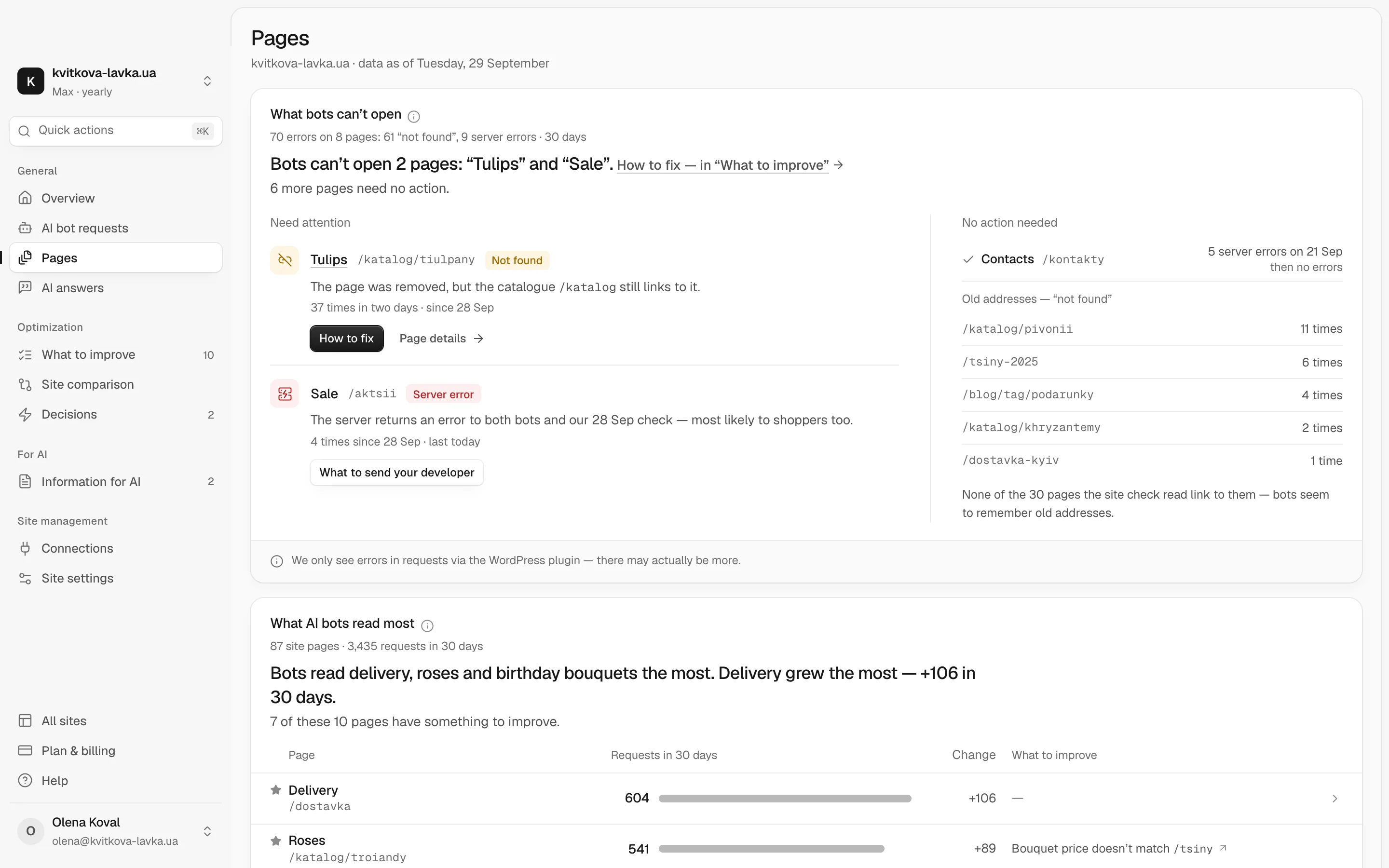
Blocking isn't the only problem. Errors also cost you. A bot that gets a 403, a 5xx error or an empty page built only with JavaScript leaves without your facts. Your site still looks fine to human visitors, so nobody notices.
Two market mistakes, and how to spot repackaged SEO
Mistake 1: buying "GEO" as a separate magic service
Many of the top results set the two disciplines up as opposites. One vendor sums it up as "SEO rewards popularity. GEO rewards parse-ability." It's a neat line. But parse-ability, meaning how easily a machine can read your page, has always been part of technical SEO. A separate GEO retainer that rewrites your pages and sends you screenshots of one ChatGPT answer gives you no measurement and no real change.
Mistake 2: dropping SEO because AI search is growing
Google's AI features use the same index as normal search. ChatGPT search and Perplexity need pages they can crawl. The budget doubts in this month's news are about paid ads. If you cut SEO, you weaken the base that AI answers are built on.
Five questions to ask a GEO vendor
- Which AI bots do you check on my site, and how? Do you use server logs or only a crawler tool?
- How do you measure Share of Model? Which questions, which engines, how often, and how many runs?
- What will you change beyond on-page SEO, for example facts on other sites, bot access or errors?
- Do you guarantee placement in ChatGPT or AI Overviews? If yes, walk away. Nobody can guarantee that.
- Will I get a baseline measurement before any work starts, and the same measurement afterwards?
If the answers are vague, you are being offered SEO with a new label, usually at a higher price.
A split checklist: what to keep for SEO, what to add for AI answers
| Keep doing for SEO | Add for AI answers |
|---|---|
| Technical health: speed, indexability, clean redirects | Fact consistency: the same prices, hours, services and contacts on your site, directories, reviews and press |
| Content that answers real customer questions | Bot access and errors: robots.txt checked bot by bot, 4xx/5xx errors served to bots, content that only appears with JavaScript |
| Structured data on key pages | Answer-first page structure: the direct answer in the first sentences, then the details |
| Earning links and mentions | Monthly tracking of mentions in AI answers with a fixed question set |
| Search Console monitoring | Server logs for AI bot visits, not only referral traffic in your web analytics |
The right column is short on purpose. It adds to SEO and doesn't replace it.
How to check whether your AI visibility is changing
AI visibility has to be measured, not promised. Write down 10–20 questions your customers really ask. Run them in ChatGPT, Gemini, Claude and Perplexity, record which answers mention you, then repeat every month.
Separately, check your server logs, the records your server keeps of every request, to see which AI bots visit and which errors they get. Microsoft Clarity has added Agentic Analytics, which tracks which AI agents visit a site. To me, that shows tracking bot traffic is becoming normal analytics.
This is what we built Chetver to do. Pulse shows which bots from ChatGPT, Claude, Gemini and others visit your site, what they read and where they hit problems. An AI Page keeps your core facts (prices, hours, contacts, services) in one place for AI. On the Max plan, AI answers asks your test questions in ChatGPT, Claude, Perplexity and Gemini every week and counts the mentions.
The before-and-after method matters more than the tool. In the Sereda.ai case, two researchers scored answers independently on 5 criteria of 10 points each, scaled to 100 and averaged over 4 questions. ChatGPT went from 24 to 87 and Gemini from 28 to 91. The "before" was measured from September to early October 2025, and the "after" in early December 2025, following an AI Page published on 22 October 2025. That is one case, not a promise.
What I would do in your place
So, is SEO dead? No. It is now the base layer for a second kind of visibility. Here is what I would do:
- Keep your SEO budget. If you need savings, first review what paid search really adds, as the media buyers in the news are doing.
- Check robots.txt bot by bot, then check server logs for errors served to AI bots.
- Make one list of your core facts and fix every source that disagrees with it.
- Record a baseline of AI answers to your key questions now, and repeat it monthly.
The easiest first step: run a free AI check to see how AI describes your business today.
Frequently asked questions
Is SEO dead because of ChatGPT?
No. Google says SEO best practices also apply to AI Overviews and AI Mode, and ChatGPT search needs pages it can crawl. The budget scrutiny reported in November 2026 is about paid search ads, not SEO.
Is GEO just SEO with a new name?
Mostly, but not completely. Crawlable pages, clear facts, structured data and earned mentions are shared. GEO adds measuring Share of Model, keeping facts consistent across other sites, and managing access for each AI bot.
Should I move my budget from SEO to GEO?
No. AI answers rely on the same foundations as SEO, so cutting SEO weakens them. Instead, add a small amount of work for fact consistency, bot access and monthly tracking of AI answers.
Do I need a separate GEO agency?
Usually not. A good SEO team already does most of the shared work. Make sure someone owns three extra tasks: fact consistency across other sites, AI bot access and errors, and monthly tracking of AI answers.
If I block GPTBot, will I disappear from ChatGPT answers?
Not because of that alone. GPTBot collects content that may be used for training. ChatGPT search uses OAI-SearchBot, and OpenAI says sites that block OAI-SearchBot won't be shown in ChatGPT search answers. In the same way, Google-Extended controls Gemini training and grounding and does not affect Google Search.
How do I measure GEO results without rankings?
Use a fixed set of real customer questions, run them in several AI engines every month, and count how many answers mention you. That share is called Share of Model. Record a baseline before you change anything.