
Ads in AI search are here. Bing now shows ads in AI Overviews, ChatGPT has shown ads since February 2026, and Google sells placements around AI Overviews and AI Mode through AI Max. These ads are labelled and kept apart from the generated answer, so they can't replace the assistant naming your business. I would earn that organic mention first, and only then decide which queries are worth paying for.
Where do ads in AI search show up today?
AI Overviews are the short AI-written summaries that Google and Bing show above or beside regular search results. Bing is not the first AI surface to carry ads. It is the latest. On 19 November 2026 the Microsoft Advertising blog announced ads in Bing AI Overviews, "building on ads in Copilot". Search Engine Roundtable reported the confirmation a day later and said it had been seeing these ads for about three weeks.
| Surface | Status | Where the ad sits | How you buy |
|---|---|---|---|
| Bing AI Overviews | Confirmed 19 Nov 2026; all markets except China | "Next to AI-powered answers" | Existing campaigns, including Performance Max and AI Max (SER) |
| ChatGPT | US test from 9 Feb 2026; 89 countries by 21 Oct 2026; Free and Go plans only | Labelled, below the response | Self-serve Ads Manager (beta) with cost-per-click bidding, or partners (OpenAI) |
| Google AI Overviews and AI Mode | Through AI Max for Search since at least late 2025 | Google selects which AI Max ads appear | AI Max for Search (Digiday) |
| Claude | No ads | — | Anthropic has promised Claude will stay ad-free (Axios) |
A few terms from the table. Performance Max is a campaign type where the ad platform's automation chooses where your ads run. AI Max for Search is Google's AI-driven setting for search campaigns that expands which queries and placements your ads reach. ChatGPT Go is OpenAI's lower-cost paid plan, at $8 a month according to CBS News.
So the picture is different for each assistant. You can buy a slot in some of them. You can be named organically in all of them.
An ad sits next to the answer. It isn't the answer
Read the vendors' own wording. Microsoft says: "Your ads can now show up next to AI-powered answers on Bing when your offers are relevant." OpenAI promises "a clear separation between ads and ChatGPT's answers" and states that "ads do not influence the answers ChatGPT gives you". It repeated this in October when it launched a new visual ad format.
That separation protects users, and I'm glad it exists. But for you it means one thing: the money buys a labelled box, not a place in the generated recommendation. If the assistant names three competitors in its answer, your ad may show up as a labelled sponsored box below that list.
Why the recommendation carries more weight than the ad unit
Ads are labelled so that people can tell them apart from the answer. When someone asks "which accountant near me handles payroll for small businesses", the list in the answer is the advice. The box underneath is someone paying to be seen. I have not found solid public data that compares trust in organic AI answers with trust in AI ads, so this is my judgement, not a statistic.
The vendors' own numbers don't answer the question either. Microsoft cites "a 21% increase in purchases after a Copilot interaction". Search Engine Land notes that this doesn't prove AI Overview ads will perform the same way. Microsoft also shared no benchmarks for the new placement.
Why an ad budget won't fix an assistant that gets your facts wrong
The organic answer still describes your business, whether you pay or not. If the assistant has your prices, services or location wrong, the ad doesn't correct that. It only puts your name next to the mistake.
For example, imagine a physiotherapy clinic that moved to a new address and added Saturday hours. ChatGPT still gives the old address and says the clinic is closed on weekends. The clinic buys an ad, and it appears below that answer with the correct details. Now the customer sees two versions of the facts on one screen, and one of them comes from the assistant they chose to trust.
The same applies when an assistant says it doesn't know your company. An ad from a business the assistant has never heard of is hard to believe. Fixing the facts at the source helps both the answer and any ad you buy later.
Why advertisers are rethinking search budgets now
The timing matters. On 2 November 2026 Digiday spoke to 18 media buyers who said Google search spend is no longer automatic. Lindsay Marty of Above the Bar Marketing said the amount being questioned is "generally around 10% to 20% of the Google budget". Bryce Hamlin of Power Digital cited 10% to 30% being moved elsewhere.
On the same day, Google moved AI Overviews for brand searches to the right-hand column. Buyers said AI Overviews and AI Mode answer more queries on the results page, which leaves fewer clicks and fewer prime ad slots.
My view is that money leaving classic search shouldn't flow straight into AI ad slots. Use this moment to find out where the assistants name you and where they don't. Then spend.
What makes you visible organically also makes your ads more credible
The work that gets you named in AI answers is the same work that makes a later ad believable. AI bots read a website differently from Google and from people. They need clear, unique facts about the business. Our piece on how visibility rules change from SEO to GEO covers this in more depth. In practice, four things matter:
- Crawlable pages. Your prices, services and contact pages must load for AI crawlers without errors and must not be blocked in robots.txt.
- Consistent facts. The same prices, hours, address and service list on your site, in your business profiles and in directories.
- Third-party mentions. Reviews, industry lists and press that describe you in the same terms.
- One clear source of facts for AI. At Chetver we build an AI Page for this: one page with your business facts, built from your website and published on your own subdomain, plus an llms.txt file. llms.txt is a plain-text file that points AI tools to your key pages. Our research on llms.txt and other AI-crawler signals explains what each signal does.
Technical details like robots.txt rules or server errors served to bots can quietly cost you mentions. An ad budget does not fix them.
When does paying for AI ad placements make sense?
I'm not saying "never buy AI ads". I'm saying buy them in the right order. Once the assistants name you correctly for your main questions, an ad can add reach. It makes sense for queries where competitors still appear in more answers than you do.
Getting started costs little now. Bing AI Overview ads run through existing campaigns, so you don't need to set up a new one. OpenAI dropped its $50,000 minimum spend when it launched self-serve buying in May. But you get little control. Microsoft offers no separate placement controls or reporting for AI Overviews, OpenAI says its ads system controls all delivery decisions, and Google selects which AI Max ads appear. So start small, on a few queries you can measure.
How do you measure AI visibility before and after?
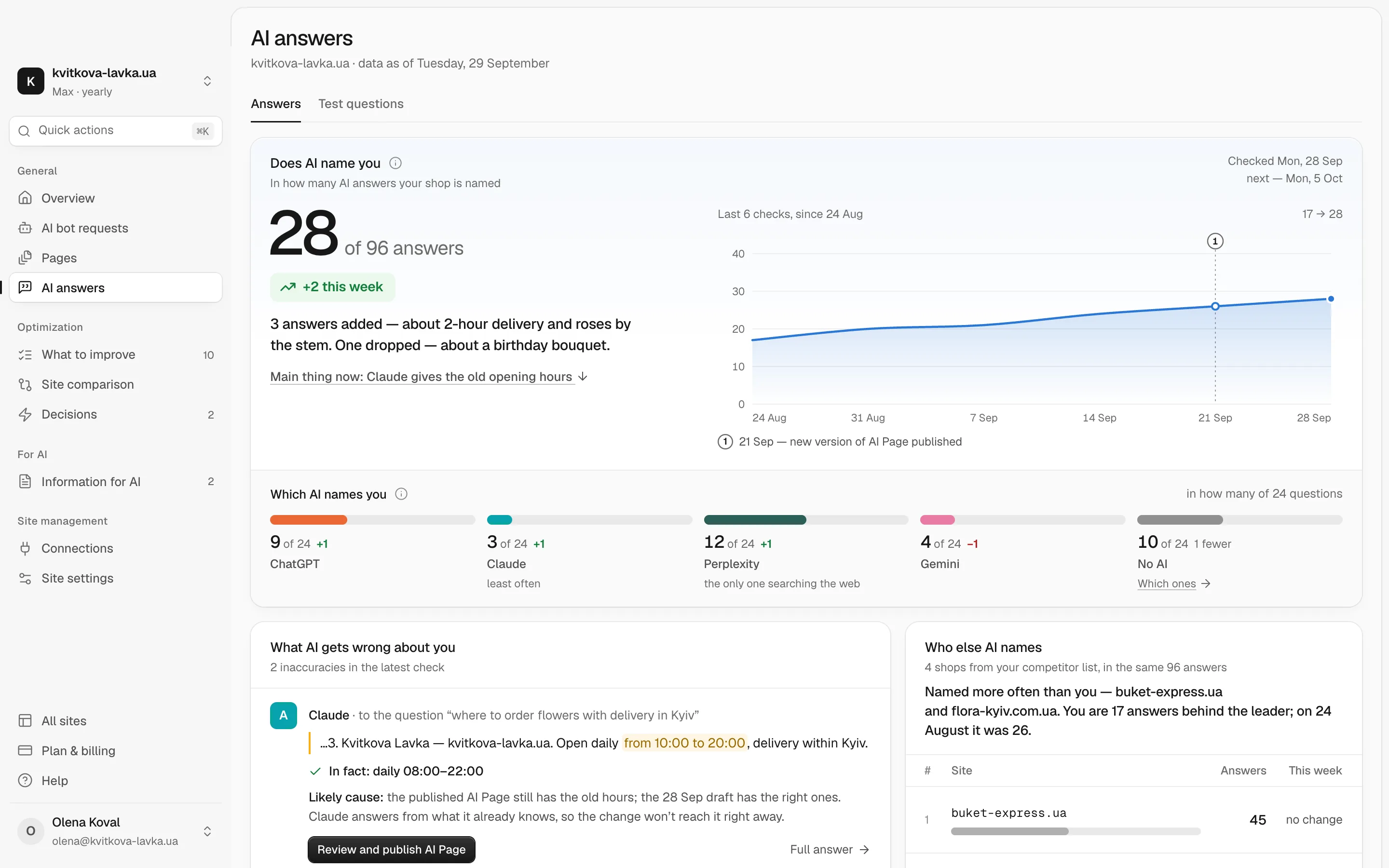
AI visibility has to be measured, not promised. A simple metric is the share of answers to your test questions that mention you. We call it Share of Model. Measure it before and after every change, including any ad test.
Here is what a measured change looks like, using a different metric: answer quality. In the Sereda.ai case, ChatGPT first said it didn't know the Ukrainian HR platform, and the product barely appeared in lists of HR tools. An AI Page was published on 22 October 2025. Two researchers scored the answers independently on 5 criteria, 10 points each, scaled to 100 and averaged over 4 questions. ChatGPT went from 24 to 87 and Gemini from 28 to 91. "Before" was September to early October 2025, and "after" was early December 2025.
You can start with the free AI check. On the Max plan, Chetver asks ChatGPT, Claude, Perplexity and Gemini your test questions every week and counts how many answers mention you.
What I would do in your place
- List 10–20 buying questions. Write them the way customers ask: "best family lawyer in Austin for a divorce", "CRM for a 10-person agency under $50 a month".
- Run them in ChatGPT, Gemini, Perplexity and Copilot. Save the answers with the date. This is your baseline.
- Note the gaps. Where are you missing? Where are your prices, services or location wrong? Which competitors appear every time?
- Check that AI bots can reach your key pages. Look at robots.txt and at errors served to bots. Pulse shows which AI bots visit your site, what they read and where they stumble.
- Fix the gaps, re-run the questions, then pick what to pay for. Test an ad budget only on queries where the assistants already describe you correctly but competitors still appear more often.
Ads in AI answers are a real channel now, and some of you will use them well. But a paid slot below an answer that ignores you is a weak place to start. This week, run your buying questions through the four assistants and write down where you're missing. That list tells you what to fix, and later, what is worth paying for.
Frequently asked questions
Does ChatGPT have ads?
Yes. OpenAI started testing ads in the US on 9 February 2026 for the Free and Go plans, and by 21 October 2026 ChatGPT Ads were available in 89 countries. The Plus, Pro, Business, Enterprise and Education plans have no ads.
Do ads change ChatGPT's answers?
OpenAI says they don't: "Ads do not influence the answers ChatGPT gives you." Ads are labelled and shown separately, below the response. Paying for an ad gets you a sponsored box, not a place in the answer itself.
Do I need a new campaign for ads in Bing AI Overviews?
No. According to Search Engine Roundtable's report on Microsoft's announcement, ads in Bing AI Overviews run through existing campaigns, including Performance Max and AI Max, in all markets except China. Search Engine Land notes that Microsoft has not shared separate placement controls or reporting for this placement.
How do ads get into Google AI Overviews and AI Mode?
The main route is AI Max for Search, Google's AI-driven setting for search campaigns. Media buyers told Digiday that Google decides which AI Max ads appear there, so you have limited control over the placement.
Can I pay to be recommended by ChatGPT or Gemini?
You can buy a labelled ad slot next to or below an AI answer, but not the recommendation itself. To be named in the answer, the assistant needs to reach clear, consistent facts about your business. No action guarantees a mention.
Does Claude show ads?
No. Anthropic has publicly promised that Claude will stay ad-free. You can still be named in Claude's answers organically when it can find accurate information about your business.